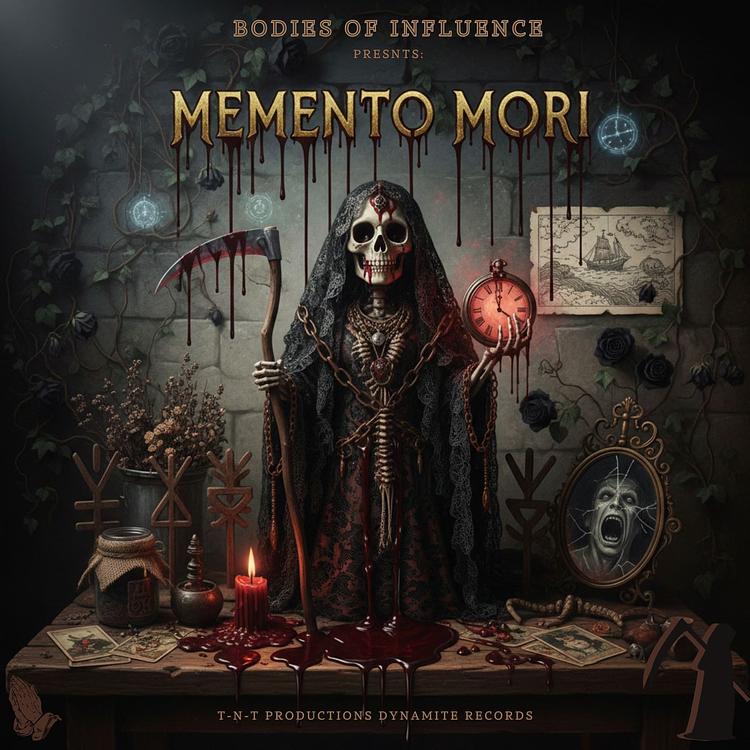
Memento Mori is a cinematic descent into the intersection of Victorian Gothic mystery and modern existential dread. Set within the crumbling walls of a cursed estate, the album explores the "soul" of inanimate objects clocks, mirrors, lace, and lead and the tragic human obsession with preserving what is meant to decay. From the haunting choral walls of the introductory invitation to the industrial, dirt-stained blues of the salt mines, the record serves as a sonic altar to mortality. It is a reminder that every masterpiece, every love, and every breath is merely a temporary keepsake held against the impending "Grand Silence."
The Philosophical Core
Memento Mori (Latin: "Remember that you must die") is more than a warning; in this album, it is an alchemical process. It draws from the Stoic practice of reflecting on mortality to find clarity, but we have infused it with the Victorian Cult of Mourning. It suggests that the "Self" is a collection of attachments objects, memories, and desires that must eventually be surrendered. Each track represents a different tether being cut.
The Esoteric Significance of the Songs
The album follows the Hermetic principle of "As Above, So Below," tracing a journey from the physical manor to the cosmic observatory.
The Alchemical Transmutation: In tracks like The Salt Cathedral and The Mercury Mirror, we see the human body being replaced by minerals (Salt, Mercury, Lead). This reflects the esoteric idea of Calcination the burning away of the ego to leave behind a crystallized, permanent essence.
The Animism of Objects: The record explores Psychometry the belief that objects can hold the "vibrations" or souls of the dead. Mourning Jewelry and The Ivy Cage suggest that we do not own our possessions; eventually, they own us, consuming our life force to maintain their own existence.
The Weaver and the Map: Silk & Shadows and The Paper Ocean tap into the Fates (the Moirai). They represent the cosmic looms and maps that dictate our lifespan. When the seamstress becomes the shadow, she is moving from the "Temporary Form" to the "Eternal Archetype."
The Clockwork Demiurge: The Clockwork Heart and The Glass Organ reflect the Gnostic idea of a "mechanical" universe. We are biological machines striving for a "spark" of divinity that we can never quite catch, leading to the "shattering" of the physical vessel.
Esoteric Symbolism in the "Grand Silence"
The album concludes with The Great Work (Magnum Opus). The transition from The Lead Balloon (Saturn/Heavy Matter) to The Graphite Observatory (Cosmos/Void) represents the soul’s ascent.
Graphite & Lead: Both are forms of carbon/metal, representing the "base" nature of man.
The Ink/Pigment: Symbolizes the Primal Waters or the Nigredo phase of alchemy the blackness of the void before rebirth. Wiping away the stars is an act of Apophasis finding God or Truth by stripping away everything that isn't true until only the "Grand Silence" remains.
Spiritual Narrative Summary
"To listen to Memento Mori is to attend your own funeral and find it beautiful. It is an occult exploration of the 'Thin Veil,' where the clinking of a teacup is as haunted as a ghost’s whisper. By the final note of The Graphite Observatory, the listener is left in a state of Tabula Rasa (a clean slate), having witnessed the dissolution of the material world into the peaceful, heavy dark of eternity."
Executive Producer & Creative Director: Thomas Scott
Production House: T-N-T Productions Dynamite Records
Lyrical Engineering: Original concepts and composition by Thomas Scott
Sonic Architecture: Multi-layered Hybrid production utilizing Akai Professional MPC One, Numark NVII, Artiphon Instrument 1, and SunoAI.
Released: July 1, 2026
License: All Rights Reserved
Tags: dark psytrance, darkstep, emocore, emo pop, folktronica, gothic, indie pop, new age, soul blues, steampunk, synth-pop